
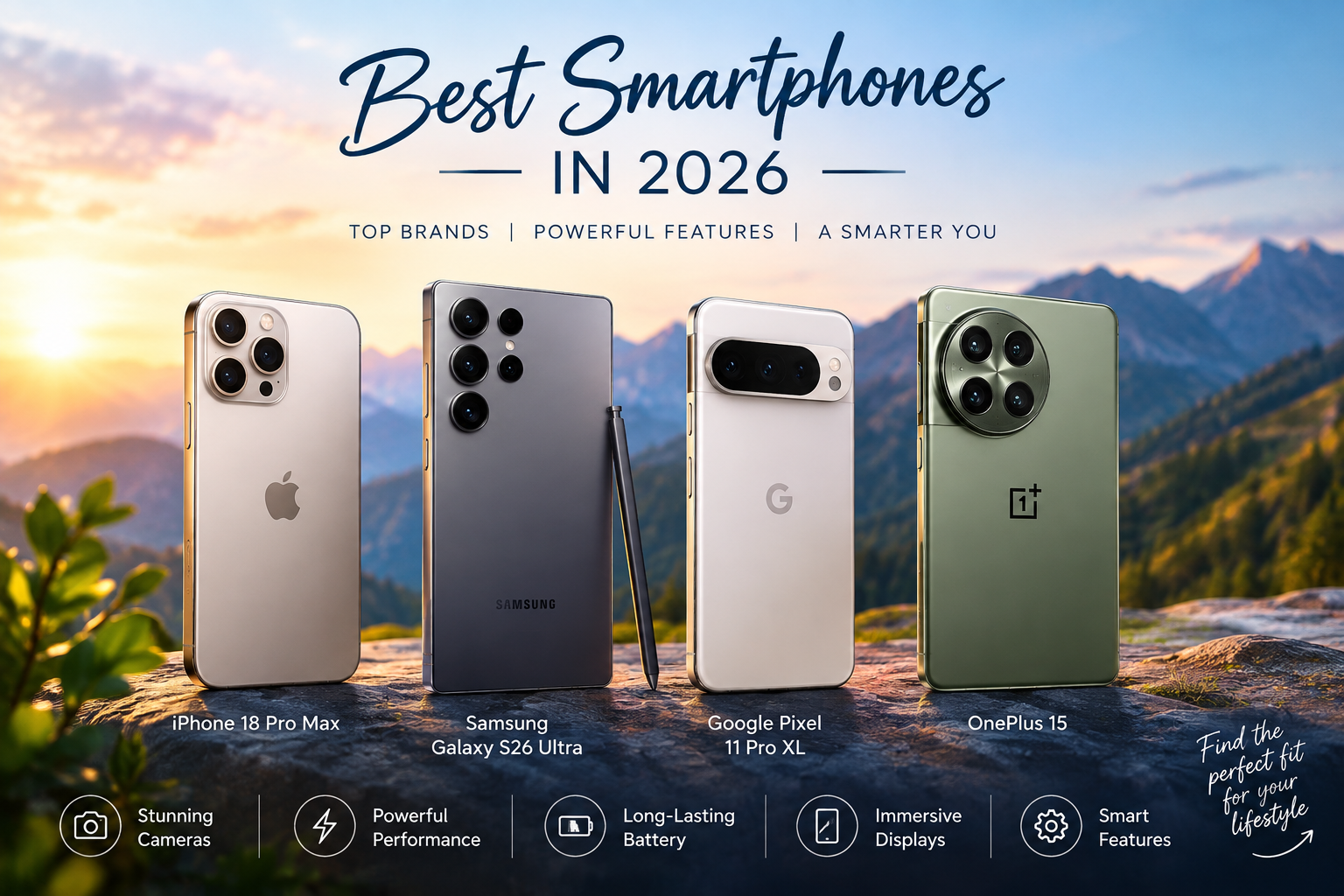
The smartphone market in 2026 is more competitive than ever. Today’s best smartphones are not defined by a single specification. Instead, manufacturers are competing across several areas, including camera quality, processing power, battery life, artificial intelligence, display technology, software experience, and innovative designs such as foldable screens.
Whether you are looking for a powerful flagship, a photography-focused smartphone, a long-lasting battery, a foldable device, or an affordable phone with premium features, there are plenty of options to choose from.
To help you find the right device, here are some of the best smartphones in 2026, covering different types of users and priorities.
Best Smartphone in 2026 at a glance
| Smartphone | Best For |
| iPhone 18 Pro Max | Overall premium experience |
| Samsung Galaxy S26 Ultra | Best Android flagship |
| Google Pixel 11 Pro XL | AI and smart features |
| OnePlus 15 | Battery life and performance |
| Xiaomi 17 Ultra | Photography |
| Samsung Galaxy Z Fold8 | Foldable productivity |
| Nothing Phone (4a) Pro | Budget-friendly design and features |
| iPhone 18 Pro | Premium compact iPhone experience |
Basically, The exact choice depends on your priorities, because a phone designed for photography may not necessarily be the best option for gaming or battery life.
1. iPhone 18 Pro Max
To begin with, the iPhone 18 Pro Max sits at the top of Apple’s 2026 smartphone lineup and is designed for users who want Apple’s most advanced combination of performance, cameras, display technology, and battery life.
Additionally, the new generation brings Apple’s A20 Pro chip, along with improvements to photography and camera controls.
Key features
- A20 Pro chip
- Premium large display
- Advanced camera system
- Variable-aperture camera technology
- High-quality video recording
- iOS 26
- Strong battery life
- Apple ecosystem integration
Why consider the iPhone 18 Pro Max?
It is particularly suited to users who want a high-end smartphone for photography, video recording, gaming, productivity, and everyday use while staying within Apple’s ecosystem.
2. Samsung Galaxy S26 Ultra
The Samsung Galaxy S26 Ultra is one of the most advanced Android smartphones of 2026.
After all, Samsung has continued to focus on combining powerful hardware with sophisticated cameras, a large display, AI-powered features, and productivity tools.
The S26 Ultra features a 200MP main camera and a high-end Snapdragon processor.
Key features
- 6.9-inch display
- 200MP main camera
- Snapdragon 8 Elite Gen 5
- Advanced telephoto cameras
- Galaxy AI features
- S Pen support
- Premium design
- Large battery
Why consider Samsung Galaxy S26 Ultra?
Because, the Galaxy S26 Ultra is a strong choice for someone who wants Android flexibility, high-end photography, powerful performance, and productivity features in one device.
3. Google Pixel 11 Pro XL
Google’s Pixel smartphones have become particularly known for photography and AI-powered software; additionally, the Pixel 11 Pro XL continues that approach in 2026.
The phone uses Google’s Tensor G6 processor and includes a range of AI-focused features. Additionally, the current reviews highlight its AI capabilities and clean Android experience.
Key features
- Google Tensor G6
- 6.8-inch display
- Up to 1TB storage
- 50MP main camera
- 48MP ultra-wide camera
- 48MP telephoto camera
- 5x optical zoom
- AI-powered features
- Clean Android experience
Why consider Google Pixel 11 Pro XL?
Because, the Pixel 11 Pro XL is a good option for people who want Google’s AI features, computational photography, and straightforward Android software.
4. OnePlus 15
If battery life is your biggest priority, the OnePlus 15 deserves a place on your shortlist.
Moreover, the phone features a huge 7,300mAh silicon-carbon battery and powerful hardware based on Qualcomm’s Snapdragon 8 Elite Gen 5 platform.
Independent testing has been particularly positive about its battery performance.
Key features
- Snapdragon 8 Elite Gen 5
- 7,300mAh battery
- Up to 165Hz refresh rate in gaming
- Fast wired charging
- Wireless charging
- High-performance hardware
- Triple-camera setup
- Durable design
Why consider it?
The OnePlus 15 is especially appealing to people who spend long hours gaming, watching videos, using social media, navigating, or working on their phone.
Its huge battery is one of its biggest advantages
5. Xiaomi 17 Ultra
For photography enthusiasts, the Xiaomi 17 Ultra is one of the most interesting flagship smartphones of 2026.
Xiaomi has focused heavily on camera hardware, including a 1-inch main sensor and a 200MP telephoto camera developed with Leica. Reviews have praised its photography capabilities, display, performance, and battery life.
Key features
- 1-inch main camera sensor
- 200MP telephoto camera
- Leica camera technology
- 6,000mAh battery
- 90W fast charging
- High-end processor
- Large OLED display
- Premium build
Why consider Xiaomi 17 Ultra?
The Xiaomi 17 Ultra is aimed at users who want a camera-focused flagship with powerful photography hardware and strong overall performance.
One limitation is availability: although it has a global version, it is not officially sold in every market, including the US.
6. Samsung Galaxy Z Fold8
Foldable smartphones have moved beyond being experimental gadgets, and the Galaxy Z Fold8 represents Samsung’s latest approach to combining a smartphone with a larger tablet-like display.
The device can be used as a conventional smartphone when folded and opened to provide considerably more screen space for multitasking.
Key features
- Large foldable internal display
- External cover display
- Multitasking support
- Premium hardware
- Advanced Samsung software
- High-end cameras
- Productivity-focused design
Why consider Samsung Galaxy Z Fold8?
A foldable can be particularly useful for people who read documents, manage multiple applications, watch videos, browse websites, or work from their phone.
7. Nothing Phone (4a) Pro
Not everyone needs to spend over $1,000 on a smartphone.
The Nothing Phone (4a) Pro offers a more affordable alternative while retaining several features associated with more expensive devices.
It has a distinctive design, bright OLED display, solid performance, and Nothing’s recognizable Glyph Matrix interface.
Key features
- 6.83-inch OLED display
- 144Hz refresh rate
- Snapdragon 7 Gen 4
- 8GB/12GB RAM
- 50MP main camera
- 50MP 3.5x telephoto camera
- 5,080mAh battery
- 50W charging
- Glyph Matrix
Why consider Nothing Phone (4a) Pro?
It is worth considering if you want a stylish smartphone with a distinctive design, good performance, and useful features without moving into flagship pricing.
8. iPhone 18 Pro
If the Pro Max feels too large, the iPhone 18 Pro provides a smaller alternative while retaining many of Apple’s flagship features.
It is aimed at users who want premium performance and cameras but prefer a more manageable form factor.
Key features
- A20 Pro chip
- Advanced camera system
- Variable-aperture camera technology
- Premium display
- iOS 26
- Strong video capabilities
- Apple ecosystem
How to choose Best Smartphone in 2026?
The “best” smartphone isn’t necessarily the phone with the most expensive price tag. Your ideal phone depends on how you plan to use it.
- Consider the Processor
For instance, a processor determines how efficiently a phone handles applications, games, multitasking, photography processing and AI features.
If you regularly play demanding games, look for a flagship processor. For basic activities such as messaging, browsing, streaming, and social media a mid range processor can be sufficient.
- Look beyond Megapixels
A 200MP camera doesn’t automatically make one phone better than another.
When comparing smartphone cameras, look at:
- Sensor size
- Image processing
- Low-light photography
- Telephoto performance
- Ultra-wide quality
- Video stabilization
- HDR
- Portrait photography
- Zoom capabilities
Phones such as Samsung Galaxy S26 Ultra and Xiaomi 17 Ultra demonstrate how manufactures are combining high resolution sensors and advance optics and computational photography.
- Check Battery capacity and Charging.
Battery capacity is measured in mAh, but a large number isn’t the only factor that determines battery life.
Additionally, the processor’s efficiency, display technology, software optimization, and your usage habits all affect how long a phone lasts.
For example, OnePlus 15 is a notable smartphone that combines a very large battery with fast charging and efficient hardware.
- Choose the right display
A high-quality display can make a major difference when watching movies, gaming, reading, and browsing.
Look for:
- OLED or AMOLED technology
- High refresh rate
- Good brightness
- HDR support
- High resolution
- Adaptive refresh rate
Gamers especially benefits from higher refresh rates, while people who watch videos may prioritize brightness and colour accuracy.
- Think about Software Support
Your smartphone’s hardware is only part of the experience.
Software updates can bring:
- New features
- Security improvements
- AI capabilities
- Performance improvements
- Bug fixes
If you plan to keep your phone for several years, check the manufacturer’s software-support policy before purchasing.
- Consider Storage
Storage becomes important if you take lots of photography and videos.
For everyday users, a lower storage configuration may be sufficient. While, content creators, gamers, and people who keep large media libraries, may benefit from 256GB, 512GB, or even 1TB storage.
Best Smartphones in 2026 for Different Needs
For an overall premium experience
iPhone 18 Pro Max
For Android users
Samsung Galaxy S26 Ultra
For AI features
Google Pixel 11 Pro XL
For battery life
OnePlus 15
For photography
Xiaomi 17 Ultra / Samsung Galaxy S26 Ultra
For foldable phones
Samsung Galaxy Z Fold8
For a more affordable option
Nothing Phone (4a) Pro
FAQ
1. What is the best smartphone in 2026?
There isn’t one phone that is ideal for everyone. Overall, the iPhone 18 Pro Max, Samsung Galaxy S26 Ultra, Google Pixel 11 Pro XL, and OnePlus 15 are among the major flagship choices in 2026, with each emphasizing different strengths.
2. Which smartphone has the best camera in 2026?
The Samsung Galaxy S26 Ultra and Xiaomi 17 Ultra are notable camera-focused choices. Meanwhile, the Xiaomi 17 Ultra emphasizes large-sensor photography and a 200MP telephoto system.
3. Which phone has the best battery life in 2026?
The OnePlus 15 is one of the strongest battery-focused smartphones of 2026. While its 7,300mAh battery has delivered exceptionally long endurance in independent testing.
4. What is the best Android phone in 2026?
The Samsung Galaxy S26 Ultra is one of the leading Android flagships of 2026. Alongside, the OnePlus 15.
5. Which is the best AI smartphone in 2026?
The Google Pixel 11 Pro XL is focused on AI, with Google’s latest Tensor G6 processor and Gemini-related features.
6. Which is the best foldable phone in 2026?
The Samsung Galaxy Z Fold8 is one of the leading foldable smartphones of 2026 for multitasking and productivity.
7. Are expensive flagship phones worth buying?
It depends on your requirements. However, flagships offer more advanced cameras, processors, displays, materials, and specialised features. Additionally, mid-range phones can be sufficient for users who mainly need messaging, social media, streaming, browsing, and everyday applications.
8. What should I look for when buying a smartphone in 2026?
So, when choosing a smartphone, consider the processor, camera system, battery life, display, software support, storage, durability, connectivity, and price instead of focusing on a single specification.
Conclusion
Choosing the best smartphone in 2026 is not simply about picking the most expensive or powerful device. Instead, the right choice depends on how you plan to use your phone, your preferred features, and your budget. Flagship models offer cutting-edge performance, advanced cameras, premium displays, and long-term software support, while mid-range options can provide an excellent balance of features and value.
Ultimately, consider the processor, camera quality, battery life, display, storage, software experience, durability, and connectivity before making your decision. Whether you prioritize photography, gaming, productivity, battery life, or everyday performance, comparing these factors can help you find a smartphone that fits your needs. With so many options available in 2026, taking the time to compare specifications and real-world features can help you make a more confident and informed purchase.