
Buying a good smartphone no longer means spending a fortune. In 2026, budget and mid-range phones offer features that were once limited to expensive flagship models, including high-refresh-rate AMOLED displays, 5G connectivity, capable cameras, fast charging, AI features, powerful processors, and long software-support periods.
However, choosing the right affordable smartphone can still be confusing. Different phones focus on different strengths. Some offer better cameras, while others focus on gaming performance, battery life, display quality, software support, or design.
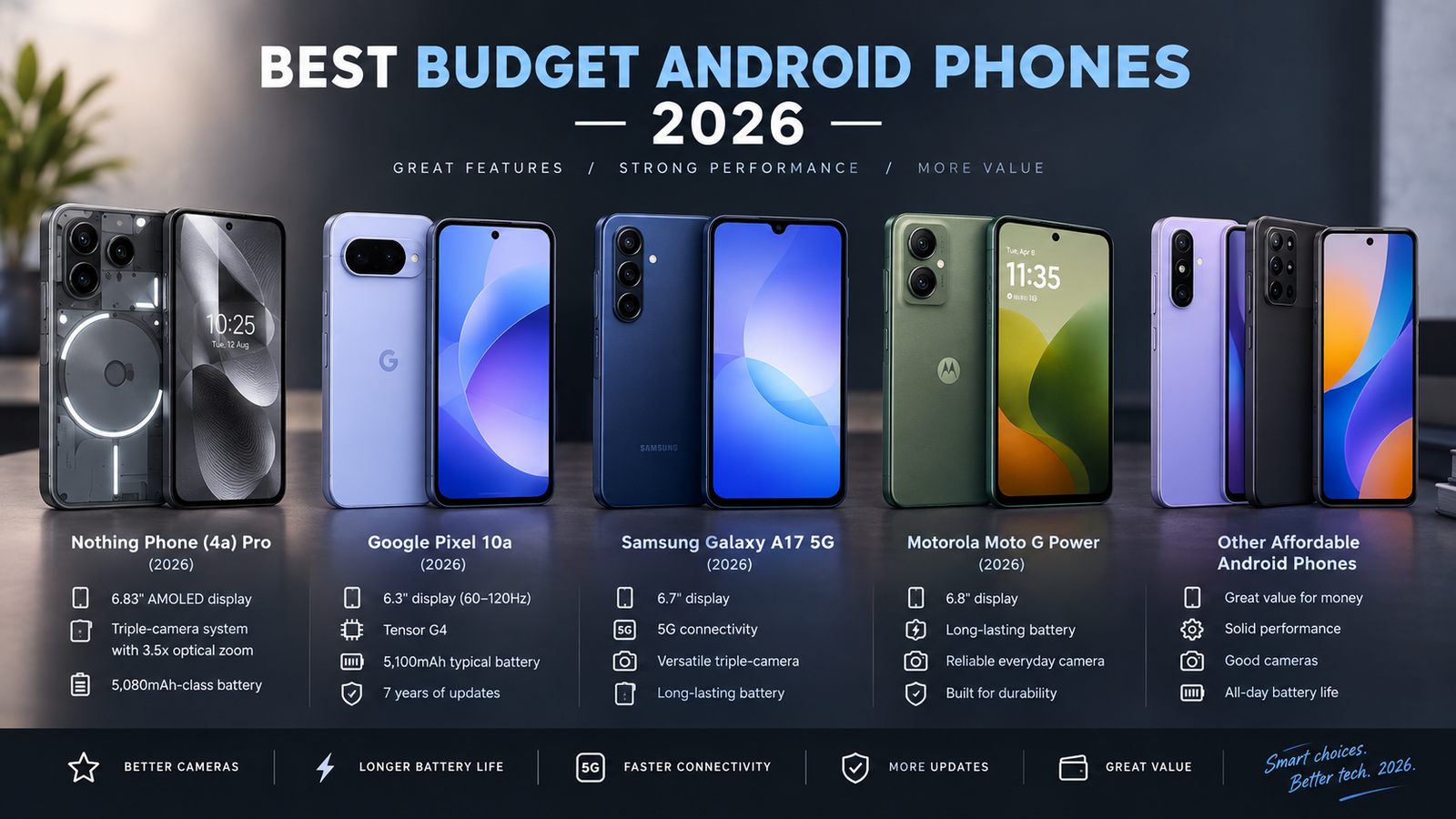
Recent 2026 smartphone guides from major technology publications include models such as the Nothing Phone (4a) Pro, Google Pixel 10a, Samsung Galaxy A17 5G, Motorola Moto G Power (2026), and other affordable Android phones among the notable options in their respective price categories.
So, instead of looking at price alone, let’s explore the best budget smartphones available globally in 2026, what makes them different, and what you should consider before buying one.
What Is a Budget Smartphone?
A budget smartphone is generally designed to provide the essential features of a modern smartphone at a lower price than premium flagship models.
The exact definition varies by country and market. For this guide, the term budget smartphone covers affordable phones generally positioned below the premium flagship segment, including devices around the $200–$500 range.
Today’s budget smartphones can offer:
- 5G connectivity
- AMOLED or high-refresh-rate displays
- Multi-camera systems
- Large batteries
- Fast charging
- AI-powered features
- Modern Android versions
- Powerful mid-range processors
- 128GB or more storage
- Long-term security updates
This means buyers no longer necessarily have to sacrifice the overall smartphone experience simply because they have a smaller budget.
Best Budget Smartphones to Consider in 2026
There isn’t one phone that will suit every buyer. The right choice depends on what matters most to you.
Here are some of the notable budget and affordable smartphones to consider:
1. Nothing Phone (4a) Pro
2. Google Pixel 10a
3. Samsung Galaxy A17 5G
4. Motorola Moto G Power (2026)
5. POCO X8 Pro
These phones cover different priorities, from cameras and software to battery life, display quality and performance.
1. Nothing Phone (4a) Pro
The Nothing Phone (4a) Pro is one of the more distinctive options in the affordable smartphone market.
Nothing combines an unusual design with a large AMOLED display, a Snapdragon 7 Gen 4 processor, a multi-camera setup and fast charging.
The phone features a 6.83-inch 1.5K AMOLED display with a 144Hz refresh rate. It is powered by the Snapdragon 7 Gen 4 and comes with 8GB or 12GB RAM depending on the configuration.
Key features
- 6.83-inch AMOLED display
- 144Hz refresh rate
- Snapdragon 7 Gen 4
- 8GB/12GB RAM options
- 128GB/256GB storage
- 50MP main camera
- 50MP periscope telephoto camera
- 8MP ultrawide camera
- 32MP front camera
- 5,400mAh battery
- 50W fast charging
- Android 16
- Nothing OS
- IP65 rating
The camera system also includes a 50MP periscope telephoto camera with up to 3.5x optical zoom, giving it more flexibility than many phones in the same broad price category.
Nothing lists the Phone (4a) Pro from $499 in the United States for the 8GB/128GB configuration. Pricing and configurations vary between markets.
2. Google Pixel 10a
Google’s Pixel A-series has become known for bringing several of the company’s software and photography features to a lower price point.
The Google Pixel 10a is particularly interesting for people who care about photography, AI features and software support.
The average testing recorded a 15-hour-16-minute battery result in its web-surfing battery test, while the phone also delivered strong benchmark results within its price category. This phone is highlighted for its camera capabilities, AI features and software support.
Why consider the Pixel 10a?
The phone can appeal to users who want:
- Strong computational photography
- Google’s AI features
- Clean Android software
- Long-term software support
- A compact design compared with some large budget phones
- 5G connectivity
- A smooth OLED display
The Pixel 10a is listed at $499 in the US, although actual retail prices can change with promotions and regional offers.
3. Samsung Galaxy A17 5G
For buyers who want an affordable Samsung phone, the Galaxy A17 5G is one of the company’s lower-priced 5G options.
Samsung’s budget lineup is particularly notable for its software-support policies. Android Central reports that the Galaxy A17 5G receives six Android upgrades, giving it a longer software-support window than many similarly priced phones.
Key features
- 6.7-inch display
- Super AMOLED technology
- 5G connectivity
- Exynos 1330 processor
- 50MP main camera
- OIS
- 5,000mAh battery
- Samsung’s One UI software
- Long software-support commitment
The Galaxy A17 5G can therefore be interesting for someone who wants a familiar Samsung experience without moving into the company’s higher-priced Galaxy A or S series.
It is also positioned considerably below $300 in some markets, although prices and configurations vary internationally.
4. Motorola Moto G Power (2026)
If battery life and durability are important, Motorola’s Moto G Power (2026) is another phone worth considering. The phone is designed around practical features rather than premium flagship specifications.
Its combination of a 1080p display, 8GB RAM, 30W charging, headphone jack and IP68/IP69 protection is the main highlight. The testing recorded 18 hours and 22 minutes for the Moto G Power (2026), making battery endurance one of its notable characteristics.
What makes it useful?
The Moto G Power can appeal to users who prioritize:
- Long battery life
- Durability
- A headphone jack
- Expandable storage
- Clean Android software
- Practical everyday performance
However, its LCD display is less premium than the AMOLED panels found on some competing phones.
5. POCO X8 Pro
For buyers who prioritize performance at a relatively low price, POCO’s X-series is another part of the global budget-phone conversation.
POCO generally focuses heavily on performance and hardware specifications, making its phones particularly attractive to users who spend a lot of time gaming or running demanding applications.
However, availability differs significantly between countries. Buyers should check whether the exact global or regional version supports their local 5G bands, warranty arrangements and network requirements.
Budget Smartphone Comparison
| Smartphone | Main Strength | Display | Processor | Battery |
| Nothing Phone (4a) Pro | Design, display & versatility | 6.83″ 144Hz AMOLED | Snapdragon 7 Gen 4 | 5,400mAh |
| Google Pixel 10a | Camera & AI | OLED | Tensor platform | Strong battery performance |
| Samsung Galaxy A17 5G | Software support & everyday use | Super AMOLED | Exynos 1330 | 5,000mAh |
| Moto G Power (2026) | Battery & durability | 1080p LCD | Dimensity 6300 | Long-lasting |
| POCO X8 Pro | Performance & value | High-refresh display | Performance-focused chipset | Large battery |
Specifications and market configurations can differ by country, so buyers should verify the local version before purchasing.
Budget Smartphones for Different Types of Users
Instead of choosing a phone purely based on its overall specifications, think about how you actually use your smartphone.
For Photography
The Google Pixel 10a is worth considering if camera processing and AI-powered photography are high priorities.
For Display and Design
The Nothing Phone (4a) Pro combines a distinctive design with a 144Hz AMOLED display and a versatile camera system.
For Long-Term Software Support
The Samsung Galaxy A17 5G stands out for its extended Android update commitment in its price segment.
For Battery Life
The Moto G Power (2026) is built around battery endurance and practical features, and it recorded 18 hours 22 minutes in the battery test.
For Performance
POCO’s X-series is aimed heavily at hardware performance, and the POCO X8 Pro appears among Kimovil’s current under-$300 options.
Are Budget Smartphones Good for Gaming?
Yes, but the gaming experience depends heavily on the processor and graphics hardware.
Casual games such as: Candy Crush, Subway Surfers, Clash of Clans, Among Us, can run comfortably on many affordable smartphones.
More demanding titles such as Genshin Impact, PUBG Mobile, Call of Duty Mobile and similar games require stronger hardware.
If gaming is your priority, look for:
- A capable GPU
- 8GB RAM or more
- High-refresh-rate display
- Good thermal management
- Large battery
- Fast charging
Don’t choose a phone purely because it has a high-refresh-rate screen. The processor must also be capable of delivering the frame rates needed to take advantage of it.
How Long Can a Budget Smartphone Last?
A good budget smartphone can potentially remain useful for several years, but longevity depends on several factors.
The processor, battery health, software support, storage, build quality and personal usage all influence how long a phone remains comfortable to use. Software support is particularly important.
A phone may still physically work after five years, but if it stops receiving security updates or newer applications become incompatible, its practical lifespan can be shorter.
Common Mistakes to Avoid When Buying a Budget Phone
Choosing Based Only on RAM
More RAM doesn’t automatically mean a better phone. The processor, software optimization and storage technology also matter.
Focusing Only on Megapixels
A 200MP camera isn’t automatically better than a 50MP camera. Sensor size, stabilization and image processing can be more important.
Ignoring Software Support
A cheap phone that stops receiving security updates quickly may not represent good long-term value.
Buying an Imported Model Without Checking Compatibility
Always check network bands, warranty coverage, charger compatibility and regional software differences.
Choosing the Cheapest Phone Available
Saving money at purchase isn’t always the same as getting good value. A slightly more expensive phone may provide better performance, cameras, software support and battery life for several years.
What Is the Ideal Budget for a Smartphone in 2026?
There is no universal price because smartphone prices vary considerably across countries.
A phone around $200–$300 can provide a strong basic smartphone experience, while moving closer to $400–$500 can bring more capable processors, better displays, improved cameras and stronger long-term features.
For example, a few under-$300 lists include several performance-focused models, while major technology guides also include phones such as the Pixel 10a and Nothing Phone (4a) Pro in the broader sub-$500 category. The best budget therefore depends on your priorities rather than a single universal price point.
Conclusion
The budget smartphone market in 2026 is more competitive than ever. Buyers can now find affordable devices with high-refresh-rate displays, 5G, capable processors, advanced cameras, large batteries and AI-powered software features.
The Nothing Phone (4a) Pro focuses on design, display technology and a versatile camera system. The Google Pixel 10a brings Google’s photography and AI features into a more affordable package. The Samsung Galaxy A17 5G emphasizes everyday usability and extended software support, while the Moto G Power (2026) focuses heavily on battery life and practical durability. POCO’s X-series provides another route for users who prioritize hardware performance.
The important thing is not simply to search for the cheapest smartphone. Instead, consider what you actually need from your phone. A student may value battery life and storage, a content creator may prioritize cameras and display quality, while a gamer may care more about the processor and cooling system.
Before making a purchase, compare the local price, warranty, network compatibility, software-support policy and available storage. Prices and availability can change between countries, so the exact regional model should always be checked before buying.
In 2026, a limited budget doesn’t necessarily mean settling for a basic smartphone. With the right research, buyers can find devices that deliver a balanced combination of performance, display quality, cameras, battery life and modern software without moving into flagship pricing.