
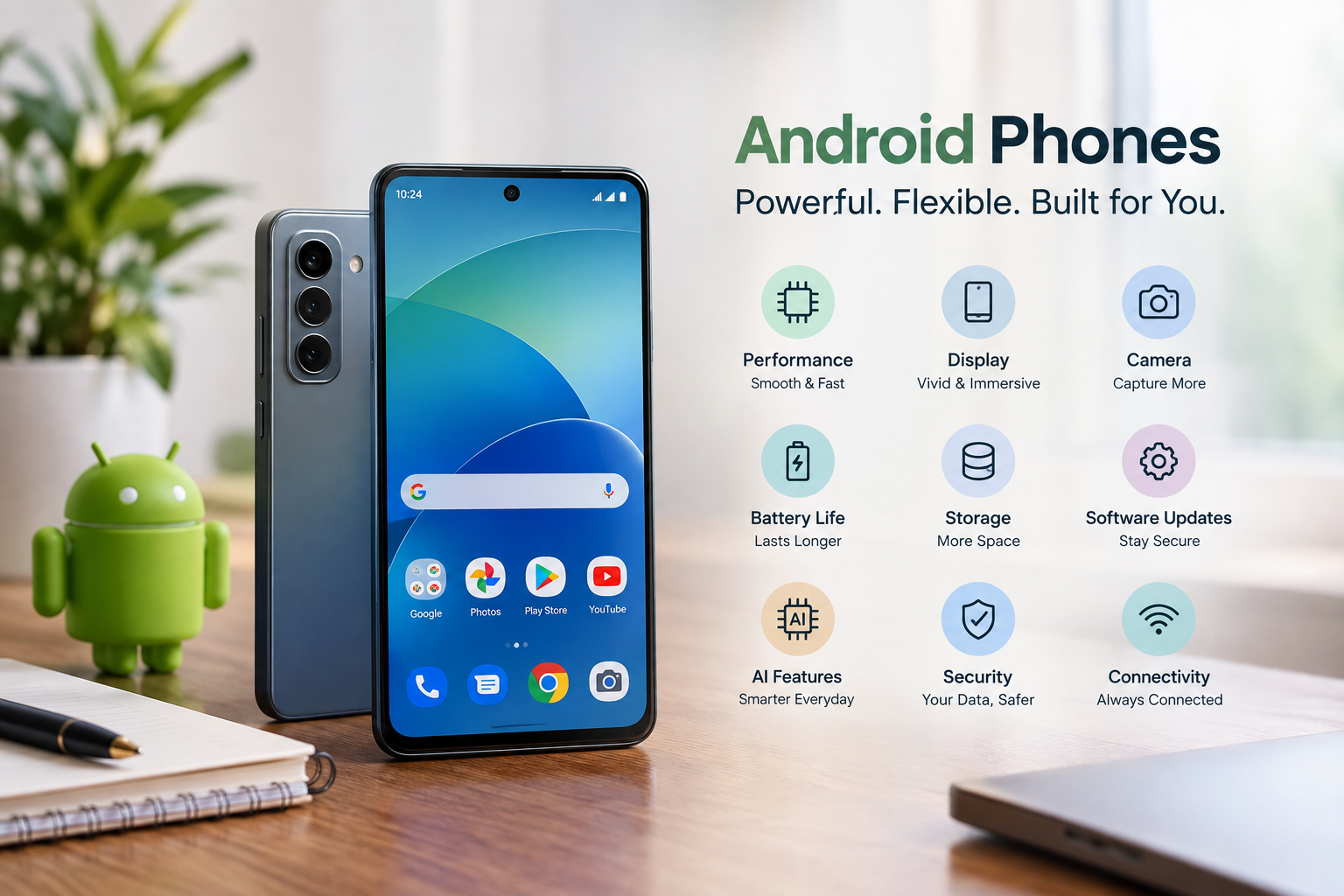
Android phones have become a major part of everyday life. From affordable smartphones for basic communication to powerful flagship devices designed for gaming, photography, productivity, and AI-powered features, Android offers options for almost every type of user.
One of the biggest advantages of choosing an Android phone is the variety available in the market. Different brands offer smartphones at different prices, with different designs, cameras, processors, displays, and software experiences. This gives users plenty of freedom to choose a device according to their budget and requirements.
But with so many choices available, finding the right Android phone can sometimes feel confusing. A smartphone that looks impressive on paper may not necessarily be the best option for your daily needs. Understanding the important features can make the buying process much easier.
What Is an Android Phone?
An Android phone is a smartphone that runs on Google’s Android operating system. Unlike a single-brand ecosystem, Android is used by many manufacturers, including Samsung, Google, OnePlus, Xiaomi, Motorola, OPPO, Vivo, Realme, and others.
This makes the Android ecosystem particularly diverse. You can find simple and affordable phones for calling, messaging, browsing, and social media, as well as premium smartphones with high-end processors, advanced camera systems, fast displays, and sophisticated AI features.
Android also gives users considerable flexibility. Depending on the manufacturer and software version, users can customize their home screens, widgets, themes, notifications, default applications, and other aspects of the interface.
Why Are Android Phones So Popular?
The popularity of Android phones comes largely from their variety and flexibility. Whether you are purchasing your first smartphone or upgrading from an older device, there is likely to be an Android phone that fits your budget.
Another major advantage is the range of hardware available across almost every price category. Someone looking for a budget smartphone does not necessarily have to compromise on every modern feature, while buyers with large budgets can explore premium devices with advance hardware.
The software experience can also vary significantly between manufacturers. Samsung’s One UI, Google Pixel’s software experience, OnePlus’s OxygenOS, Xiaomi’s HyperOS, and other Android interface provides different designs and features while being based on the same underlying operating system.
Choosing the Right Android Phone
The best Android phone for you depends largely on how you intend to use it. Instead of simply looking for the phone with the highest specifications, think about the activities you perform every day.
If you mainly use your phone for daily activities like- WhatsApp, Instagram, YouTube, browsing, online payments, calls and photography you may not need an extremely powerful flagship processor. A well optimized mid-range phone can provide a smooth experience, while keeping the price reasonable.
On the other hand, user who regularly play demanding games, edit videos, use multiple application simultaneously or work on resource-intensive applications may benefit from a more powerful processor and additional RAM.
Your budget should also be considered alongside long-term usage. Spending slightly more on a phone with better software support, stronger hardware and adequate storage can sometimes be more practical than buying an inexpensive device that needs to be replaced soon.
Processor and Performance
The processor is one of the most important components of an Android phone because it influences how efficiently the device handles applications, games, multitasking, photography processing, and AI features.
Modern Android smartphones use processors from companies such as Qualcomm and MediaTek, while some manufacturers also use their own chipsets. A newer processor generally offers improvements in performance and power efficiency, although the processor name alone should not determine your purchase.
Software optimization also plays an important role. Two phones with similar specifications can feel different during everyday use because manufacturers may optimize their software differently.
For regular activities such as browsing, streaming videos, social media, messaging, and light gaming, a capable mid-range processor can be more than sufficient. Heavy gamers and professional users may benefit from higher-end chipsets designed to handle demanding workloads.
How Much RAM Do You Need?
RAM helps an Android phone handle multiple applications and processes at the same time. More RAM can be useful when switching between several demanding applications, but simply choosing the phone with the largest RAM number is not always necessary.
For everyday users, a phone with reasonable amount of RAM and good software optimization can provide a smooth experience. Users who frequently multitasks, play demanding games, edit content or keep many applications open may benefit from additional RAM.
It is also worth remembering that manufacturers sometimes use software-based memory expansion features. These can use parts of the phone’s storage as additional virtual memory, but they are not exactly as same as having physical RAM.
Display Quality Matters
The display is something you interact with every time you use your phone, so it deserves more attention than many buyers give it.
Modern Android phones can come with LCD, OLED or AMOLED displays. Premium smartphones commonly use AMOLED or similar technologies because they can produce deeper blacks, strong contrast, vibrant colours, and excellent viewing experience.
Refresh rate in another important specification. A 90Hz, 120Hz, or higher refresh rate can make scrolling, animations, and supported games feel smoother compared with traditional 60Hz displays.
Brightness is equally important, especially when you use your phone outdoors. A display looks good indoors may become difficult to see under direct sunlight if its outdoor brightness is limited.
Screen size should also match your preference. Larger displays are useful for watching videos, gaming, reading and productivity, while smaller phones can be easy to hold and carry.
Android Phone Camera Quality
Camera specifications have become one of the biggest selling points of modern smartphones. However, choosing a camera should involve more than looking at the megapixel number.
Image processing, sensor size, stabilization, lens quality, software optimization and computational photography all influence the final photograph.
A phone with a high-megapixel camera does not automatically produce better images than a phone with a lower-resolution sensor. In real-world photography, factors such as dynamic range, color processing, low-light performance, autofocus, and stabilization can make a significant difference.
If you enjoy photography, look at the entire camera system. A useful combination may include a primary camera, an ultrawide camera, and a telephoto camera. The exact setup varies between devices, especially across different price ranges.
Battery Life and Charging
Battery life can determine how convenient a smartphone feels throughout the day. A phone with excellent performance is less useful if its battery constantly needs charging.
Battery capacity is commonly measured in milliamp-hours, or mAh. However, capacity alone does not tell the complete story. Processor efficiency, display technology, software optimization, network usage, screen brightness, and individual habits all influence how long a phone lasts.
Fast charging has also become common across many Android phones. It can be particularly useful for people with busy schedules because a short charging session can provide several hours of additional use.
Wireless charging is another feature found primarily on selected mid-range and premium smartphones. While it is convenient, it may not be essential for every user.
Storage: How Much Is Enough?
Storage determines how much space you have for applications, photographs, videos, documents, games, and other files.
If you mainly use messaging applications, social media, streaming services, and basic applications, moderate storage may be sufficient. However, people who take lots of photographs, record high-resolution videos, download movies, or install large games can quickly use up available space.
A phone with expandable storage can provide additional flexibility, although many premium smartphones no longer include a microSD card slot.
For long-term use, choosing more storage than you currently need can be sensible, especially if you plan to keep the phone for several years.
Android Software and Updates
Software support is one of the most important factors to consider when buying an Android phone.
Android manufacturers have improved their software-update policies significantly over the years. Some premium smartphones now receive several years of operating system and security updates, helping users keep their devices secure and usable for longer.
Regular security updates are particularly important because smartphones contain sensitive information such as personal photographs, messages, banking applications, passwords, and payment information.
AI Features on Android Phones
Artificial intelligence has become increasingly common in modern smartphones. Android devices now use AI for photography, translation, writing assistance, voice features, search, image editing, productivity, and personalization.
Some smartphones can automatically remove unwanted objects from photographs, improve images, summarize information, translate conversations, or assist with writing.
However, AI features vary considerably between devices. Some are processed directly on the phone, while others may depend on cloud-based services. Certain features may also be limited to specific models or regions.
Security Features
Modern Android phones offer several ways to protect personal information. Depending on the device, users may have access to fingerprint sensors, facial recognition, PINs, passwords, and other security features.
Biometric authentication can make unlocking the phone convenient, while a strong PIN or password provides an additional layer of protection.
Android also includes security features designed to protect applications, personal information, and the device itself. Keeping the operating system and applications updated is an important part of maintaining smartphone security.
Connectivity and Other Features
Connectivity is another area worth considering when buying an Android phone. Depending on the model, you may find 5G support, Wi-Fi 6 or newer standards, Bluetooth, NFC, GPS, and USB-C connectivity.
5G can provide faster mobile data speeds where compatible networks are available, although the actual experience depends on network coverage, your carrier, location, and plan.
NFC can be useful for contactless payments and other compatible services, while USB-C has become the standard connector for charging and data transfer across many modern smartphones.
Features such as stereo speakers, water and dust resistance, wireless charging, eSIM support, and high-quality haptics can also improve the overall experience, particularly on higher-end devices.
Common Mistakes to Avoid When Buying an Android Phone
One common mistake is choosing a smartphone solely because it has a high megapixel camera, large RAM capacity, or a very large battery. Individual specifications do not always tell you how the entire device will perform.
Another mistake is ignoring software updates. A phone may have impressive hardware, but limited software support can affect its long-term usefulness and security.
Buying more performance than you actually need can also unnecessarily increase your spending. At the same time, choosing a very basic phone when you regularly play demanding games or edit videos may result in a frustrating experience.
Conclusion
An Android phone is no longer simply a device for calls and messages. It has become a camera, entertainment system, communication tool, productivity assistant, navigation device, gaming machine, and increasingly an AI-powered companion.
With options available across almost every price range, Android gives users the freedom to choose a smartphone based on their individual needs. Processor performance, display quality, camera capabilities, battery life, storage, software support, security, and connectivity all contribute to the overall experience.
The best approach is to look beyond individual specifications and consider how all these features work together. Whether you are looking for an affordable everyday smartphone or a premium device packed with advanced technology, understanding these factors can help you make a more informed Android phone purchase.
Frequently Asked Questions About Android Phones
1. What is an Android phone?
An Android phone is a smartphone that runs on Google’s Android operating system and is offered by various manufacturers.
2. How much RAM is enough for an Android phone?
For everyday use, 6GB to 8GB of RAM is generally sufficient, while heavier users may prefer more.
3. How long does an Android phone usually last?
A good Android phone can last several years with proper care, regular updates, and healthy battery maintenance.
4. What should I consider when buying an Android phone?
Consider the processor, display, camera, battery, storage, software support, connectivity, and your personal usage needs.
5. Are expensive Android phones better than budget phones?
Premium phones generally offer more advanced features and hardware, but a budget or mid-range phone can provide excellent value for everyday use.