
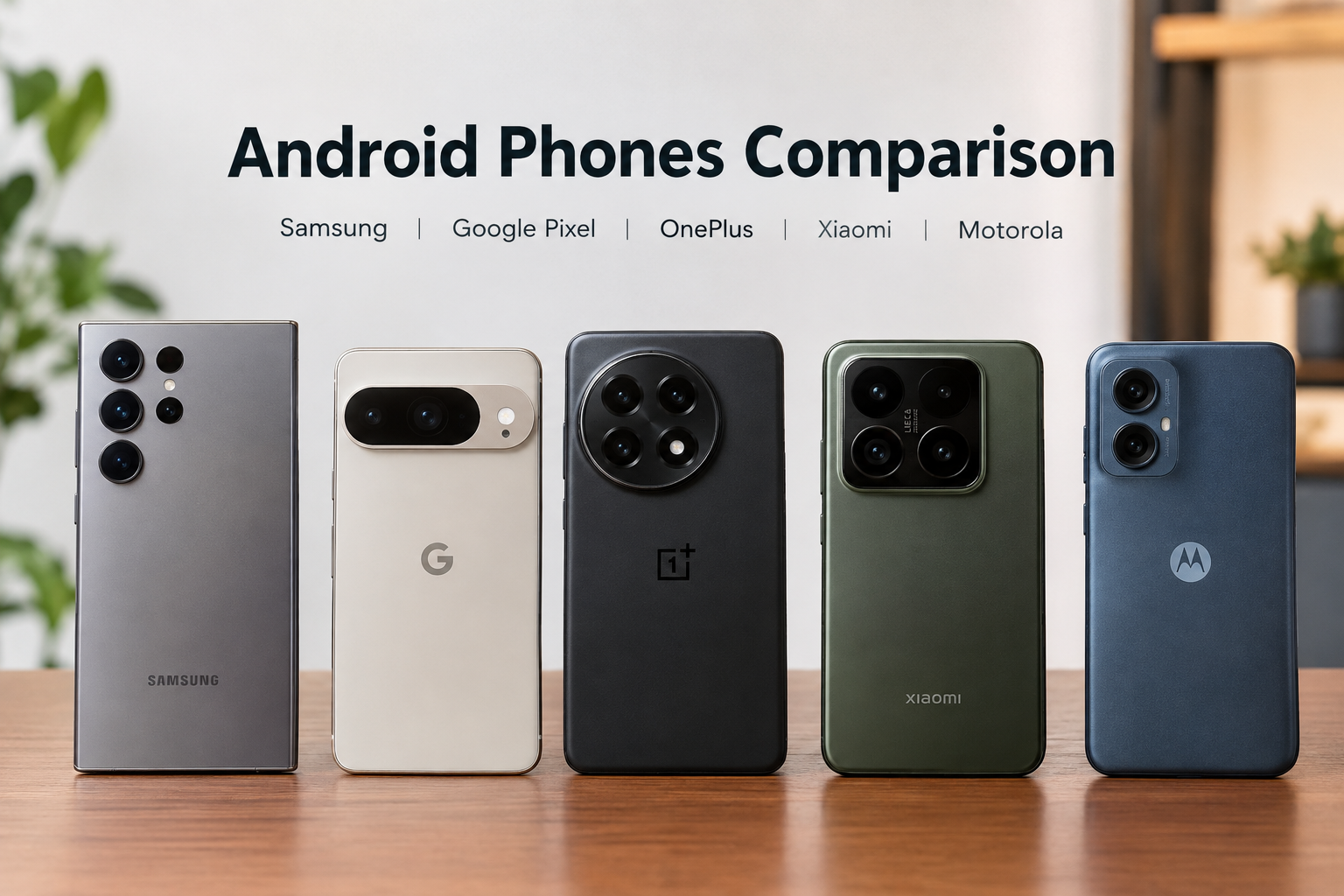
Choosing an Android phone can be surprisingly difficult. The market is filled with smartphones from different brands, price ranges, and specifications, and each manufacturer focuses on different features. Some phones emphasize cameras, others focus on gaming performance, while some offer long battery life, premium displays, or extended software support.
This makes an Android comparison more useful than simply looking at the price of a phone. Two smartphones may cost almost the same but provide very different experiences. Understanding the differences in performance, display, cameras, battery, software, storage, and design can help you decide which type of Android phone suits your needs.
What Should You Compare When Buying an Android Phone?
When comparing Android phones, it is important to look at the complete smartphone rather than focusing on one specification. A phone with a powerful processor may not have the best camera, while another device with an excellent camera may compromise on charging speed or software features.
Your daily usage should therefore be the starting point. If you mainly use social media and messaging applications, your requirements will be different from someone who plays demanding games or edits videos.
The most important areas to compare include performance, display, camera quality, battery life, charging, storage, software, design, connectivity, and long-term support.
Let’s have a look at the comparison of different Android phones:
Android Phones Comparison Table
| Feature | Samsung Galaxy S26 | Google Pixel 10 | OnePlus 15 | Xiaomi 17 | Motorola |
|---|---|---|---|---|---|
| Display | 6.3″ AMOLED, 120Hz | 6.3″ OLED, 120Hz | 6.78″ LTPO, 165Hz | 6.3″ OLED, 120Hz | Varies by model |
| Processor | Galaxy-optimized chipset | Tensor G5 | Snapdragon 8 Elite Gen 5 | Snapdragon 8 Elite Gen 5 | Varies by model |
| Main Camera | 50MP | 48MP | 50MP | 50MP Leica | Varies by model |
| Telephoto | 10MP, 3x | 10.8MP, 5x | 50MP, 3.5x | 50MP, 60mm | Varies by model |
| Battery | 4,300mAh | 4,970mAh | 7,300mAh | 6,330mAh | Varies by model |
| Charging | Up to 69% in ~30 min* | 30W | 120W | 100W | Varies by model |
| Software | Android / One UI | Android / Pixel UI | OxygenOS 16 | HyperOS 3 | Android / Hello UI |
| AI | Galaxy AI | Google AI | OnePlus AI | Xiaomi AI | Motorola AI |
| Ecosystem | Galaxy | OnePlus | Xiaomi | Motorola / Lenovo |
*Samsung’s stated charging figure depends on its testing conditions. Specifications can vary by market and model configuration.
Which Android Phone Suits Different Users?
The interesting thing about these phones is that they are not designed around exactly the same priorities.
Someone interested in Samsung’s display technology, Galaxy AI, compact design, and connected ecosystem may naturally look toward the Galaxy S26.
Whether a person who values Google’s Android experience or AI-powered photography, Pixel-exclusive features, and long-term software support may be more interested in the Pixel 10.
For users who put gaming, performance, high refresh rates, battery capacity, and extremely fast charging high on their list, the OnePlus 15 offers a specification set built strongly around those areas.
Xiaomi 17 takes a different route by combining a compact flagship design with a large battery, fast charging, Snapdragon performance, and Leica-branded camera hardware.
Motorola’s appeal depends more heavily on the specific model, but its cleaner Android approach and distinctive hardware make it an alternative to the larger Samsung, Google, OnePlus, and Xiaomi ecosystems.
The current Android market shows just how different smartphones can be even when they belong to the same operating system.
Conclusion
Samsung, Google, OnePlus, Xiaomi, and Motorola all use Android, but each company has developed its own approach to hardware, software, cameras, AI, charging, and ecosystem features.
The Galaxy S26 puts emphasis on a compact premium design, AMOLED display, Galaxy AI, and Samsung’s connected ecosystem. The Pixel 10 combines Google’s software experience with Tensor-powered AI and computational photography. Meanwhile, the OnePlus 15 focuses heavily on performance, gaming, a 165Hz display, huge battery capacity, and extremely fast charging. Xiaomi 17 combines flagship performance with Leica cameras, a large battery, and fast wired and wireless charging. Additionally, Motorola continues to provide a different Android experience through its own interface and hardware designs.
That variety is ultimately what makes Android phones interesting. Instead of every manufacturer building the same type of smartphone, buyers can choose between different combinations of camera technology, performance, software, battery life, design, and AI features.
For a buyer, the most useful comparison is therefore not simply about finding the phone with the biggest specification. It is about understanding what each Android phone is designed to do well and matching those strengths with your own everyday needs.
Frequently Asked Questions About Android Phone Comparison
1. Which Android phone is best for everyday use?
A phone with balanced performance, good battery life, a quality display, reliable cameras, and long-term software support is suitable for everyday use.
2. Which Android phone is best for gaming?
Phones with powerful processors, efficient cooling, high-refresh-rate displays, and large batteries are generally better suited for demanding gaming.
3. Which Android phone has the best camera?
Camera quality depends on the specific model, but flagship phones from Samsung, Google Pixel, OnePlus, and Xiaomi offer advanced photography systems.
4. Which Android phone offers the best battery life?
Android phones with large batteries and efficient processors can provide excellent battery endurance, with actual results depending on individual usage.
5. Is Samsung better than Google Pixel?
Samsung and Google Pixel offer different Android experiences, so the better choice depends on preferences for hardware, cameras, software, AI features, and ecosystem.
6. Is OnePlus good for performance?
Yes, OnePlus flagship phones typically emphasize powerful processors, fast displays, gaming performance, and rapid charging.
7. Are Xiaomi phones good for photography?
Many Xiaomi flagship phones offer advanced camera hardware, with some models featuring Leica-developed or co-engineered camera systems.
8. Which Android phone has the best display?
Samsung, Google, OnePlus, and Xiaomi all offer high-quality displays, with differences in brightness, refresh rate, resolution, and panel technology.
9. How important is software support when choosing an Android phone?
Software and security updates are important because they can keep a phone secure, compatible, and useful for a longer period.
10. Which Android phone is best for AI features?
Samsung and Google integrate AI extensively into their smartphones, while OnePlus, Xiaomi, and Motorola also provide various AI-powered tools.
11. Should I choose a flagship Android phone or a mid-range phone?
A flagship is useful for demanding performance and advanced features, while a good mid-range phone can be sufficient for everyday tasks at a lower price.
12. What should I compare before buying an Android phone?
Compare the processor, display, cameras, battery, charging, storage, software support, design, connectivity, and features that match your personal usage.